What It Costs to Fill a Stadium in Spanish
Bad Bunny's World's Hottest Tour (2022) grossed over $400M according to Pollstar — the highest-grossing tour of that year. This piece uses that documented figure alongside Karol G's Bichota Tour data to explain the economics of stadium reggaetón: ticket splits, production costs, and promoter risk.
Artist guarantee — the floor payment a promoter commits before a ticket is sold; the artist receives this whether the show sells out or not
Photo: Jose David Cortes / PexelsThe numbers that changed the conversation
A certification is a document before it is a decoration — each body counts units its own way.
Photo: cottonbro studio / PexelsBad Bunny's World's Hottest Tour closed 2022 as the highest-grossing concert tour of the year, per Pollstar, with a gross exceeding $400 million across stadium dates that sold out arenas and open-air venues from San Juan to Los Angeles. That figure was not just a record — it was a proof of concept. It demonstrated, in a language the concert industry had not previously heard at that scale, that a Spanish-language artist working primarily in reggaetón and Latin trap could sustain the kind of production budgets, routing costs, and ticket revenues that had previously been the domain of anglophone pop behemoths. The tour ran more than sixty shows, mostly in the United States, and the domestic dominance of the routing was itself a statement: this was not a Latin market phenomenon supplemented by American dates. It was an American stadium tour that happened to be conducted almost entirely in Spanish.
Karol G's Bichota Tour, which ran across 2021 and 2022, added a second data point. Smaller in gross than Bad Bunny's run but significant for its own reasons, the Bichota Tour demonstrated that the stadium model was replicable beyond a single artist. Karol G sold out Estadio Azteca in Mexico City among other marquee stops, and the tour's routing — which incorporated Latin American capitals alongside North American arenas — reflected a different geographic logic. Where Bad Bunny's 2022 routing leaned heavily on the United States, Karol G's operation proved that the regional circuit from Bogotá to Mexico City could support production at a level previously reserved for the most expensive tier of touring.
How the money actually moves
Stadium economics in the live music industry run on a model that has not changed structurally in decades, even as the numbers have inflated dramatically. The promoter — a Live Nation, an Ocesa, or a regional operator — guarantees the artist a flat fee or a percentage split of the gross, whichever is higher. That guarantee is the floor the promoter must pay whether or not the building sells. The production rider — the technical specification for staging, lighting rigs, video walls, and sound — is either supplied by the artist's touring company or contracted locally, and its cost sits largely on the promoter's side of the ledger in venue-provided configurations, or on the artist's side when they travel their own rig.
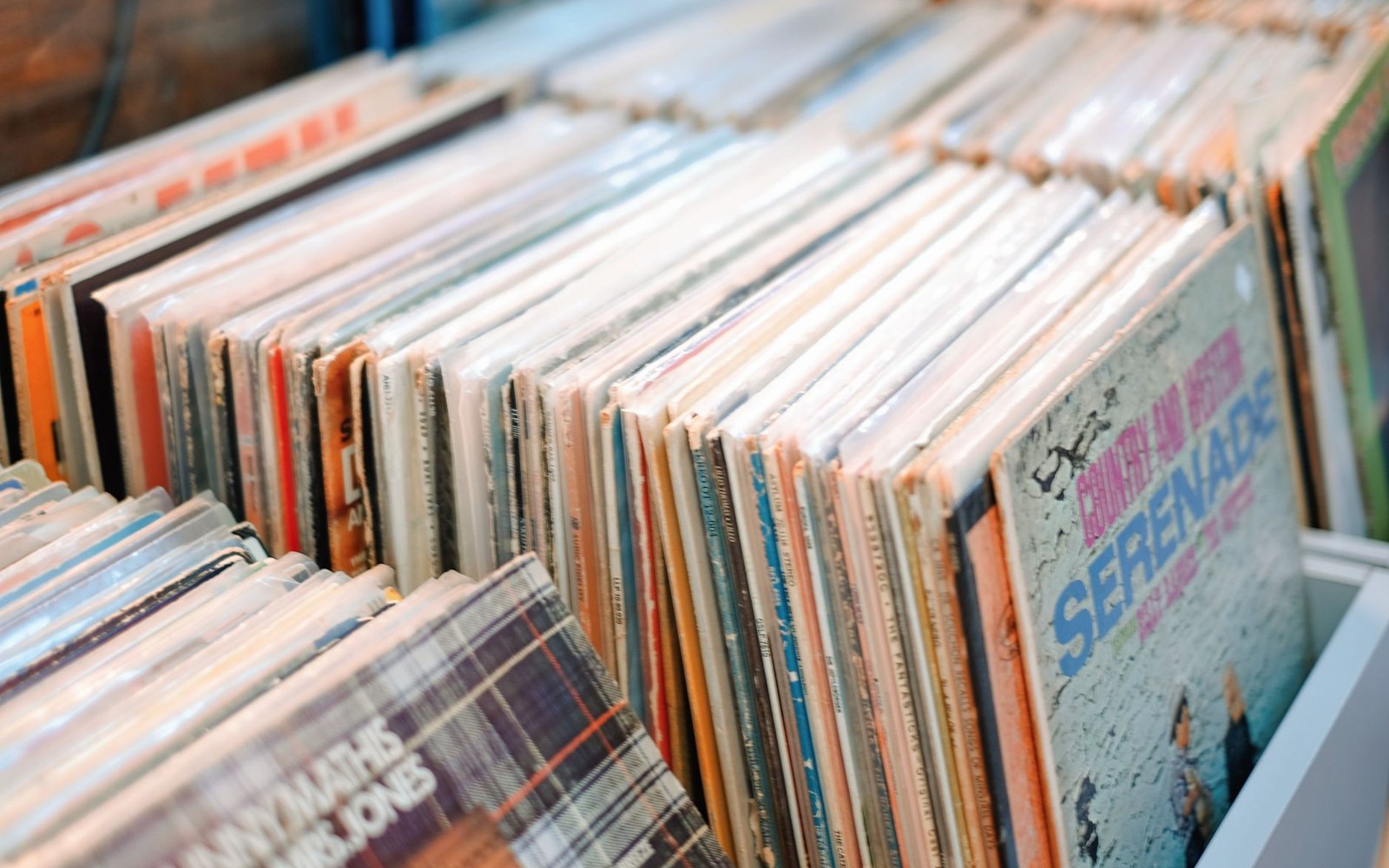
Physical racks still decide what a catalogue looks like in the country that pressed it.
Photo: Zeynep M. / PexelsFor a stadium reggaetón tour at the scale Bad Bunny operated in 2022, production costs are not publicly itemised, but industry convention places full staging for a top-tier stadium show somewhere between four and eight million dollars per installation for the largest configurations — and a tour of sixty-plus dates requires either multiple traveling rigs or extensive local buildout agreements. Ticketing revenue is then split between the venue (typically taking between ten and fifteen percent of the face-value gross as its house fee), the promoter (whose margin is what remains after the artist guarantee, production, staffing, marketing, and venue costs are covered), and the artist, who receives their guarantee or split and then pays their own road crew, management commissions — typically fifteen to twenty percent — and travel.
The Latin urbano touring economy adds one variable that complicates this standard model: the geography of the audience does not map neatly onto any single promoter's territory. An artist like Bad Bunny draws heavily from Puerto Rican diaspora communities in the northeastern United States, from Mexican American audiences in the southwest, and from Central American communities across multiple metro areas. Promoters routing a Latin stadium tour must therefore negotiate with regional operators across a landscape that does not behave like a single national market. Live Nation holds significant share of the North American side; Ocesa, now a Live Nation company, handles much of the Mexican and Latin American routing. The consolidation of those relationships under one corporate roof has made the logistics more tractable, but it has also concentrated the gatekeeping.
What promoter risk looks like at this scale
The promoter's guarantee to a stadium-level artist in the urbano space is a commitment made well before ticket sales are tested. For an artist at Bad Bunny's level in 2022, industry observers estimated per-show guarantees in the range that makes a single cancellation — a weather event, a health issue, a permit problem — a six- or seven-figure liability. Insurance covers some of this through event cancellation and non-appearance policies, but premiums for high-value live events are themselves a material cost, and the deductible structures mean the promoter absorbs the first tranche of any loss.
The money chain
- Artist guarantee — the floor payment a promoter commits before a ticket is sold; the artist receives this whether the show sells out or not
- Promoter margin — what remains of gross ticket revenue after the guarantee, production, venue fee, marketing and staffing costs are covered; the promoter bears the loss if costs exceed revenue
- Venue house fee — typically ten to fifteen percent of face-value gross, paid to the stadium operator off the top
- Management commission — fifteen to twenty percent of the artist's gross earnings; taken before the artist's net is calculated
- Dynamic pricing — a variable face-value system that prices high-demand seats toward secondary-market levels at point of sale; used by Ticketmaster and competitors
- Non-appearance insurance — a policy covering the promoter against cancellation costs if the artist cannot perform; premiums are a material line item at stadium scale
Ticket pricing is where this risk gets partially redistributed. The dynamic pricing systems now used by Ticketmaster and competing platforms allow promoters to adjust face-value prices toward secondary-market levels on high-demand dates, capturing some of the resale margin that would otherwise leave the primary ecosystem entirely. Bad Bunny's 2022 tour generated considerable public debate over dynamic pricing and platinum seat designations — a mechanism by which the best seats are priced to market at the point of sale rather than at a fixed face value. The conversation around that tour was sharp enough that it touched on questions of access for the predominantly working-class Latino audiences who form the core fan base, a tension that does not resolve easily when production costs are running at the scale they were.
Karol G's Bichota Tour navigated a version of the same tension in Latin American markets, where ticket prices at premium tiers represent a far more significant share of median monthly income than equivalent tiers in the United States. The routing decision to play Estadio Azteca — which holds upward of eighty thousand for concert configurations — rather than a smaller venue is itself an economic calculation: the per-unit cost of production spread across a larger audience reduces the average price needed to cover costs, in theory making the event more accessible. In practice, venue-fee structures and the cost of security and staffing for an eighty-thousand-capacity event complicate that arithmetic.
What the grosses mean beyond the tour itself
A $400 million gross does not translate to $400 million in artist revenue. By the time the venue fees, the promoter's margin, the production costs, the crew payroll, the management commissions, and the road taxes and local withholding fees in various jurisdictions are accounted for, the artist's net is a fraction of the headline number — typically cited in industry discussions as somewhere between fifteen and thirty-five percent of gross depending on deal structure and cost allocation. Still, at the scale Bad Bunny operated, even the lower bound of that range represents a figure that reorders the economics of an artist's career and, more consequentially for the industry, signals to promoters, insurers, and venue operators that Spanish-language stadium touring is a reliable asset class, not a speculative bet.
That reclassification matters for the artists who come after. Promusicae, Spain's music industry certification body, and equivalent bodies across Latin America track recorded-music consumption; the live sector runs on a different set of relationships, but the two are linked. An artist whose streaming footprint is large enough to justify a stadium routing — whose Spotify monthly listener count and regional streaming market share can be translated, with reasonable confidence, into projected ticket sales — is the artist promoters will back with a meaningful guarantee. Bad Bunny's tour proved that Spanish was a viable primary language for that projection. Every stadium run that follows is, in part, capitalising on that proof.
Key figures in context
- Bad Bunny's World's Hottest Tour (2022): over $400 million gross, per Pollstar — highest-grossing tour of that year
- Sixty-plus dates, routed predominantly across the United States
- Estadio Azteca concert capacity: upward of eighty thousand, used by Karol G on the Bichota Tour
- Artist net of gross: industry convention places it between fifteen and thirty-five percent after all costs, varying by deal structure